
Mount Gambier. New World Etna?
If you’ve never heard of Mount Gambier wine, you’re probably not alone.
Mount Gambier/Berrin is Australia’s newest wine region and was only officially added as a viticultural region in 1982. Berrin is the traditional lands of the Boandik Peoples on the Limestone Coast, close to the Shipwreck Coast.
Mount Gambier is the second biggest city in South Australia. Roughly five hours’ drive from both Adelaide and Melbourne, it has been more renowned for its rock lobster, abalone, and dairy and grazing agriculture. Farmers have raised lamb, beef, and other livestock and produce that has thrived on the rich, volcanic soils. More famous regional neighbours Coonawarra, Padthaway, and Wrattonbully are further north up the Limestone Coast.
Volcanics are a big part of the story here.
The wine region sits on the dormant volcano of Mount Gambier. The fertile countryside is dotted around with sinkholes and lake-filled craters, like the iconic, electric azure-coloured Blue Lake (Warwar meaning Crow country) and the Umpherstone Sink Hole (Balumbul meaning Buttercup flower).
While it is generally flat (63-104 metres above sea level), Mount Gambier formed as part of an interaction between both changing sea levels during the last ice age and the ‘new volcanics’ along the southern margin of South Australia.
Firstly, the region was once a sedimentary basin under an ancient, warm sea. The thick foundation of limestone bedrock was built up over time by ancient marine fossils. As the sea level retreated, it left stranded beach dunes and lagoons on the land.
Secondly, the region is on the edge of a huge volcanic province that stretches from Mount Gambier in South Australia to the Macedon Ranges in Victoria. It started 65 million years ago during the rifting apart of Antarctica, Tasmania, and mainland Australia. Then the weakness in the earth’s crust from the southeast corner of SA, east to the Victorian border led to an outpouring of lava and ash through fissures and craters (like the famous Blue Lake/Warwar) running from the present town of Mount Gambier northeast to the town of Glencoe.
The climate also sets the region apart.
Mount Gambier is also the coolest region in South Australia by a long way. Right now, it is home to a handful of wineries, making small productions or selling parcels of fruit, and tending towards plantings of earlier ripening varieties like Chardonnay and Pinot Noir for sparkling wine. But the region will be one to watch as the climate inevitably warms. Just as some sites, once considered marginal in Tasmania, Macedon, Gippsland, have begun producing ethereal cool climate wines.
Sitting on a coast plain on a relic beach dune system, Mount Gambier has abundant underground water access and proximity to the Southern Ocean. With a similar climate to Chablis and Burgundy in France, and Marlborough in New Zealand. And a temperate maritime climate, with the sea breezes mitigating temperature extremes (average 18.9°C during the growing season).
Mount Gambier may be a young region with an ancient terroir, but certainly appears future proofed. I tasted two wines made by producers from other regions, who sourced parcels from Mount Gambier, and one from a local family returning to their roots. I was excited by the vein of minerality across the bracket, which reminded me of the volcanic signature of Sicily’s Mt Etna wines.
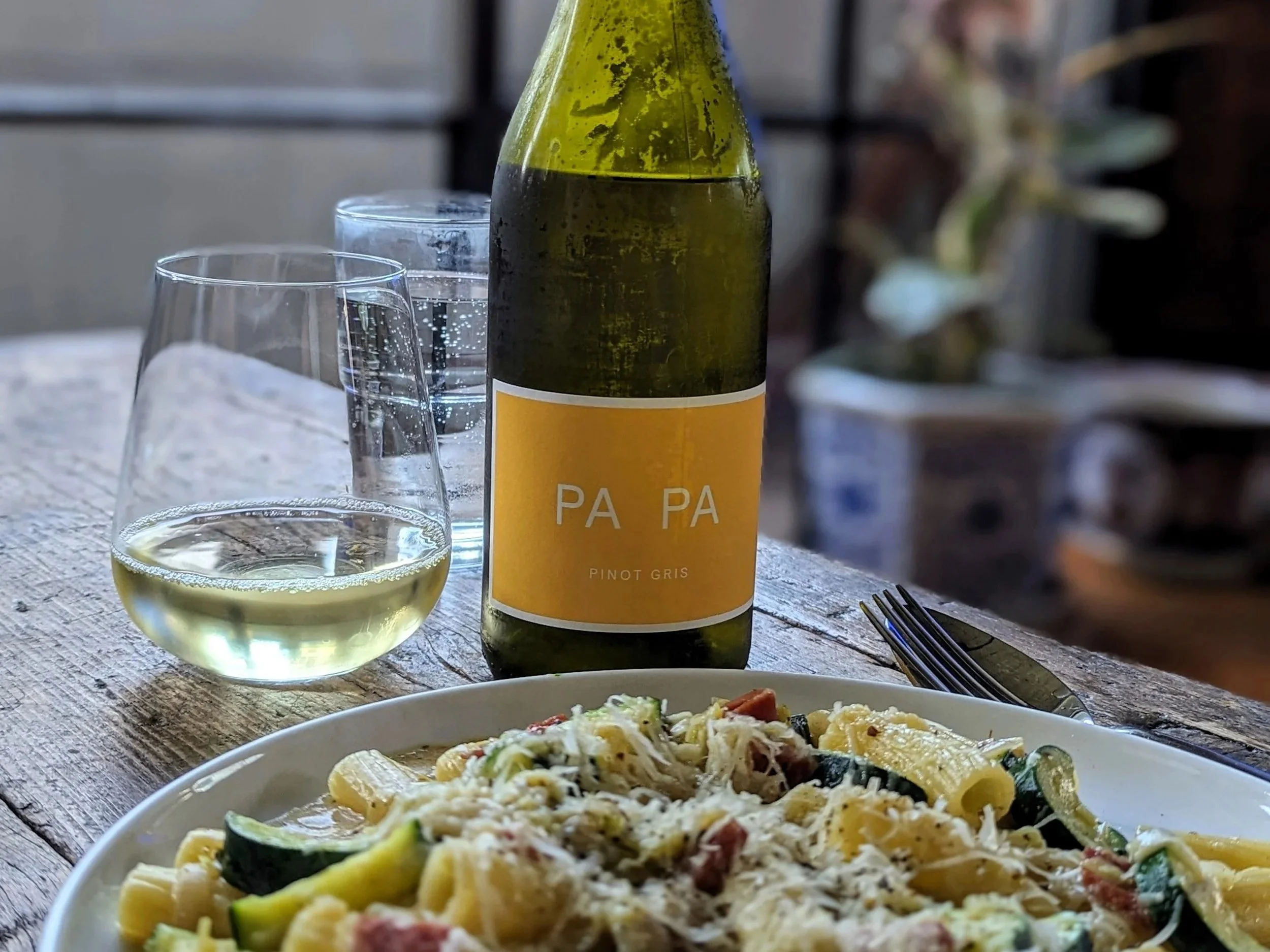
PAPA Pinot Gris 2023
Classic Pinot Gris notes of green William pear, cottage garden flowers, and honeyed beignet. With interesting notes of sweet pea, meadow grass, pawpaw, ground ginger spice and a lick of white pepper. There is good texture and yeasty/lees-y characters with a slippery feel (13.7% Alc./Vol.) that reminds of melted lemon butter.
Organic, sustainable producer Xavier Goodridge (@xaviergoodridge) grows and makes Xavier wines in Gippsland and sources fruit for the PAPA range; this parcel of Pinot Gris grown in Mount Gambier. Direct pressed, soft extraction, fermented and aged in stainless steel, on lees for five months. Tasted on 24 Feb ’24, Root Day. I had it with Rigati with sautéed zucchini, leek, saucisson and loads of parmesan.
Ottelia Sauvignon Blanc 2023
Savoury, mineral Sauvignon Blanc - Ottelia Sauvignon Blanc 2023 - pretty asparagus tips, snap peas, passionfruit tendrils, and lemon rind on the nose. Then clean, zesty lemon citrus and grapefruit on the palate with lots of minerality (saline, limestone, flint, and ironstone), and interesting artichoke, elderflower, and clover. A little white pepper with good persistence.
Label is named after Ottelia Oralifolia, a local native water lily. Vignerons Melissa and John Innes are Coonawarra based with 40 years of experience on the Limestone Coast. John did 20 vintages in Coonawarra before they est. Ottelia (@ottelia_wine). This parcel of fruit was sourced from the Ellis family’s Mount Gambier vineyard. It had 36 hours on skins then basket pressed to stainless steel, with 10% kept on lees for two weeks. Tasted on 9 May ’24, Root Day. Just 11% Alc./Vol. so it was great with a big salad for lunch.
2022 Good Intentions ‘Frankie '22’ Cabernet Franc
Is this the New World answer to Etna Red? I really liked 2022 Cabernet Franc, 'Frankie '22'. Good Intentions call it ‘Volcanic wine from Berrin/Mount Gambier - grown on the southside of one of Australia's youngest volcanoes.’
As advertised, I definitely sensed the volcanic minerality (especially flint and iron notes). It's spicy with star anise and juicy with redcurrant, blueberry, sour cherry, and wild strawberry. And there's leather, musk, and varietal herbaceousness. A lo-fi, natural vibe.
Andrew and Louise Burchell from Good Intentions Wine (@good_intentions_wine) moved back to Andrew's home to raise daughter Frankie and make cool climate, volcanic wines, fed by clean water of the limestone aquafer. Handpicked, 8-10 days wild ferment on skins, twice daily pumped over. (Tasted on 23 Jan ’24.)
Bio
Kim Pearce is the principal of Wine Brain. A Melbourne-based wine marketing consultancy est. 2014. She has worked for more than 15 years in wine marketing, communications, and events for small family-owned, large, and international producers. She likes to bring the story behind the wine to life and has a PhD Cultural Studies, Master of Arts, Bachelor of Arts Honours.
Further reading